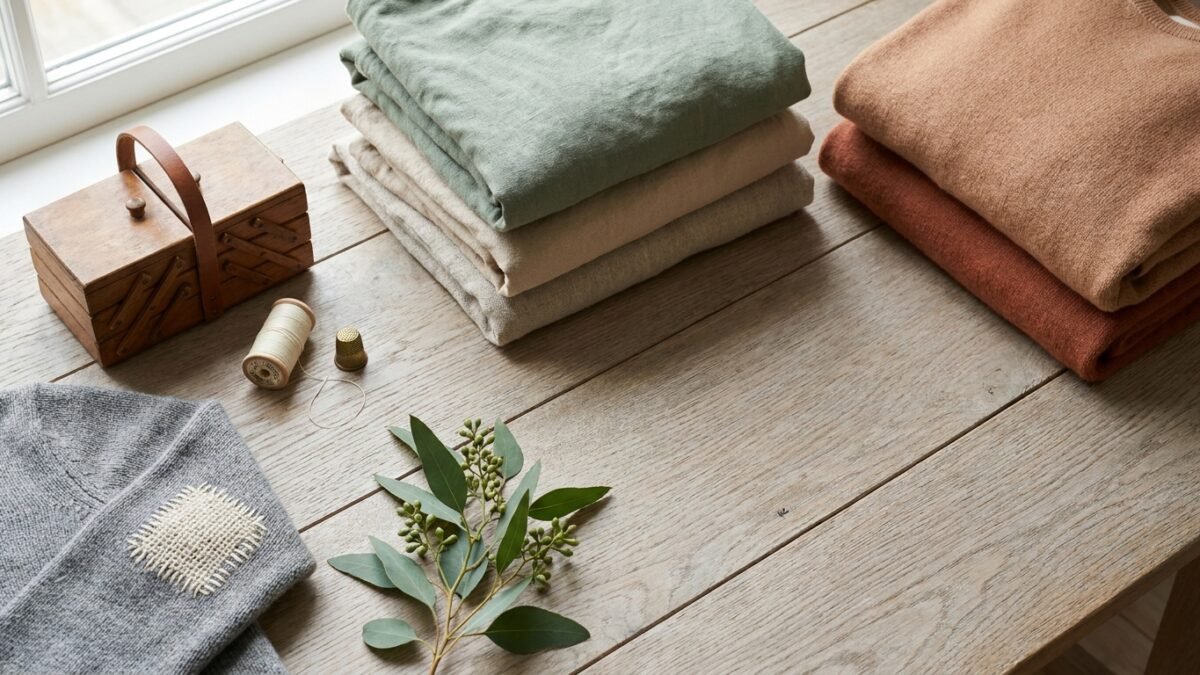
People who type “what is sustainable fashion?” into a search bar usually expect a one-line definition, but the honest answer is a little wider than that. The phrase describes a way of designing, making, selling, wearing and disposing of clothes that tries to reduce harm to the planet and to the people who make our garments, and it is used in slightly different ways by brands, researchers, regulators and shoppers.
This guide explains the definition, how it differs from related terms such as ethical and slow fashion, which environmental numbers hold up and which are disputed, what common labels really prove, and how new European rules on greenwashing and textile waste are changing what brands are allowed to say as of November 2026.
Quick Facts at a Glance
| Aspect | Quick answer |
|---|---|
| Plain definition | An approach to designing, making, buying and reusing clothes that tries to limit harm to the environment and to workers |
| Official definition | No single universally accepted one; the idea grows out of the UN’s 1987 concept of sustainable development |
| Other names | Eco-fashion, green fashion and ethical fashion overlap with it but are not identical |
| Opposite model | Fast fashion, built on speed, volume and low prices |
| Simplest habit that helps | Wearing garments for longer; UNEP has said that doubling the time each item is used could halve the industry’s emissions |
| Biggest caution | Several widely shared fashion statistics are disputed, and the word “sustainable” on a label is not proof of anything |
What Is Sustainable Fashion in Simple Terms?
The shortest accurate answer is that sustainable fashion is a movement and a set of practices aimed at moving the whole fashion system toward better environmental health and fairer treatment of people. A widely used description stresses that it covers more than fabrics and finished products, because it also involves how clothes are marketed, sold, used and thrown away. The word “sustainable” comes from the idea of sustainable development, which the United Nations described in 1987 as meeting the needs of people today without damaging the ability of future generations to meet their own.
Even so, there is no single agreed definition, and that is a real weakness rather than a small detail. Good On You, a fashion rating platform, points out that no brand or purchase is fully sustainable today, so the most honest wording is “more sustainable” rather than “sustainable”. Critics go further: New York Times fashion critic Vanessa Friedman has argued that the term is an oxymoron, because the two words seem to pull in opposite directions.
That tension is why the question “what is sustainable fashion?” gets different answers from a researcher, a brand and a shopper. It also explains why many designers, activists and policymakers now use the label cautiously, especially when companies that produce enormous volumes of clothing describe themselves as sustainable.
How It Relates to Ethical, Slow and Circular Fashion
These terms are often used as if they mean the same thing, yet each stresses a different part of the problem, and a brand can do well on one while doing very little on another. Slow fashion is usually credited to Kate Fletcher of the Centre for Sustainable Fashion at the University of the Arts London, who is widely reported to have introduced the term around 2007, borrowing from the slow food movement.
| Term | Main focus |
|---|---|
| Ethical fashion | Fair wages, safe workplaces and humane treatment of workers and animals |
| Slow fashion | Fewer collections, durable design and buying less overall |
| Circular fashion | Keeping materials in use through repair, resale and recycling so garments do not become waste |
| Eco or green fashion | Lower environmental impact in materials and production, often through natural or recycled fibres |
| Upcycled and secondhand | Giving existing garments a new life through redesign, thrifting, swapping or rental |
Fast fashion sits at the opposite end of this spectrum. It is a method of producing inexpensive clothing quickly to follow the latest trends, and the Ellen MacArthur Foundation has linked it to more collections per year and lower prices than the traditional fashion calendar.
What Is Sustainable Fashion Trying to Fix?
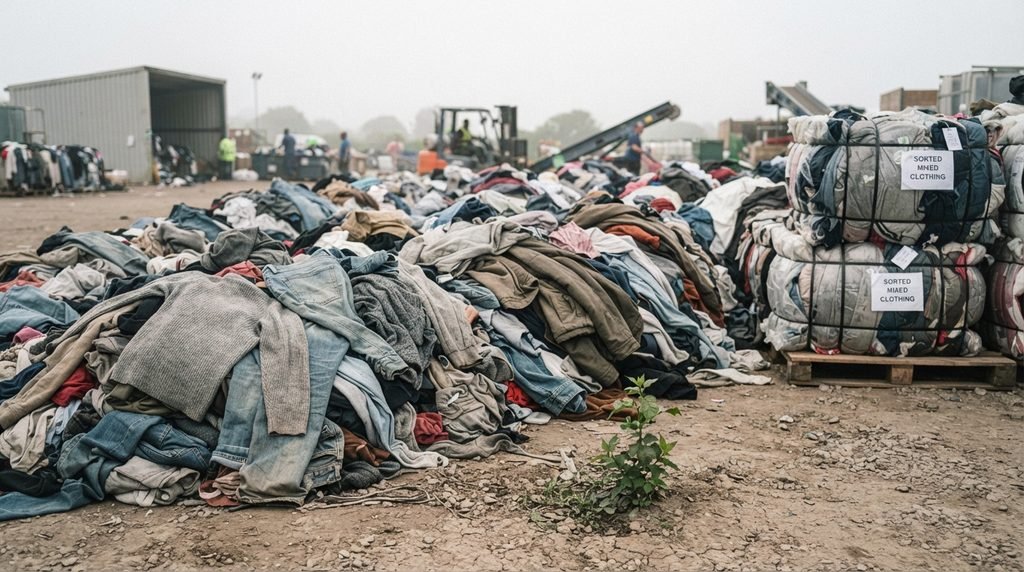
The goals make more sense after looking at what the Ellen MacArthur Foundation found in its 2017 report, A New Textiles Economy, which is still one of the most cited studies on the subject. It reported that clothing production roughly doubled between 2000 and 2015 to more than 100 billion garments a year, while clothing utilisation, meaning the average number of times a garment is worn before it stops being used, fell by 36% over the same period. The report also found that less than 1% of the material used to make clothing is recycled into new clothing, and that 87% of the total fibre input is landfilled or incinerated.
Waste is the other pillar of the debate. The United Nations Environment Programme (UNEP) says the industry produces about 92 million tonnes of textile waste a year, which it compares to a garbage truck full of clothes being discarded or burned every second. In the European Union alone, around 12.6 million tonnes of textile waste is generated each year, according to a recycling-industry summary of EU figures.
Which Popular Statistics Are Disputed
Many popular explainers repeat the claim that fashion causes 10% of global carbon emissions, and some add that it is the second most polluting industry after oil. Journalists who tried to trace the “second most polluting” claim, including a New York Times fashion critic, could not find a study behind it, so it is best treated as an urban legend rather than a fact. The 10% figure is shaky too: one journalist traced it to a 2010 trade magazine article that referred to the entire textile industry, not just clothing.
UNEP’s own current wording is a range of 2% to 8% of global greenhouse gas emissions, and UNEP official Elisa Tonda said in a 2025 interview that the range comes from two studies, with a 2018 analysis by Quantis at the top end. The Apparel Impact Institute estimates about 944 million tonnes of CO2 equivalent a year, or roughly 1.8% of the global total. Lutz Walter, secretary general of a European textile technology platform, argues in a trade-press column that the real figure is closer to 2% to 3.5% and that the 10% number has even been used as a baseline in EU impact assessments; that is one expert’s view, so the safest summary is that fashion’s exact share is not settled and falls somewhere between about 2% and 8% depending on the method.
Water figures are similarly inconsistent. A 2019 UN News report cited 93 billion cubic metres a year, a figure attributed to UNCTAD that equals 93 trillion litres, while a later UNEP statement cited 215 trillion litres and a 2025 UNEP interview cited 250 trillion litres. The sources reviewed do not explain the gap, so no single water figure is publicly confirmed. The popular claim that fashion produces 20% of global wastewater has also been questioned by trade-press reporting, which traced it to a vague attribution to the World Bank that the bank denied.
The Human Side: Workers and Safety
Environmental numbers tend to get the headlines, yet the social side triggered much of the modern debate. On 24 April 2013, the Rana Plaza building near Dhaka in Bangladesh collapsed, killing more than 1,100 garment workers and injuring around 2,500, and it is widely described as the deadliest garment-factory disaster on record. Published death tolls range from about 1,130 to 1,138 depending on the source, which is why this guide says “more than 1,100”, and cracks in the structure had been spotted the day before the collapse.
The main response was the Accord on Fire and Building Safety in Bangladesh, a legally binding agreement between more than 200 apparel brands and retailers and global unions, which later evolved into broader successor agreements. According to figures published by labour-rights groups, inspectors under the Accord identified more than 122,000 safety violations, and over 90% of them were fixed. The episode showed that fair treatment of workers depends on enforceable agreements rather than good intentions alone.
Materials and Recycled Polyester
Fibre choice is where many shoppers start looking, and it is also where easy answers fall apart. Polyester accounts for more than half of the global fibre market according to Textile Exchange data reported in trade media, and it is made from fossil fuels. Recycled polyester looks like an obvious fix, but a trade report on Textile Exchange findings put it at only 12% of polyester production in 2024, with 98% of it made from plastic bottles rather than old clothing. Textile Exchange and a UN climate initiative had set a target of 45% recycled polyester by 2025, and the latest figure available at the time of writing falls well short of it, although confirmed data for 2025 had not yet appeared.
The bottle route is criticised because bottles can be recycled into new bottles again and again, whereas bottle-based textiles usually end up in landfill or incineration. Textile-to-textile recycling is the answer many brands are pursuing, yet it supplied less than 1% of the global fibre market in 2021, according to Textile Exchange figures reported by Business of Fashion, and it remains held back by collection, sorting, blended fabrics and cost. A separate Textile Exchange lifecycle study found that recycled polyester is not automatically low-carbon, because the electricity source and recycling technology can matter more than the recycled-content label. This is one more reason the question “what is sustainable fashion?” cannot be answered by looking at a fibre name alone.
Certifications and Labels: What They Do and Do Not Prove
Independent labels can help, but each one checks something different, and a product can carry one without meeting the standards of another. A garment can be OEKO-TEX certified without being organic, for example, or made in a bluesign-approved supply chain.
| Label | What it mainly checks | What it does not tell you |
|---|---|---|
| GOTS | Organic fibre content plus processing and social criteria along the supply chain | Built around organic fibres, so it is not a guide to recycled synthetics |
| OEKO-TEX Standard 100 | Finished products and components tested for listed harmful substances | Nothing about organic content or labour conditions |
| Fairtrade | Fair pay and safe working conditions for farmers and workers | Focuses on pay and conditions rather than chemicals or fibre type |
| B Corp | Social and environmental performance of the whole company | It is a company-level rating, not a guarantee about any single garment |
It also helps to notice whether a label applies to a product, a factory or a whole company. OEKO-TEX STeP, for instance, is a facility-level certification that is often confused with the product-level Standard 100, so a claim that a brand is “OEKO-TEX certified” deserves a follow-up question about which one is meant.
Greenwashing and the New EU Rules
Vague marketing has long been the weakest point in this field, and Europe has now acted on it. Directive (EU) 2024/825, known as the Empowering Consumers for the Green Transition Directive, began applying across the EU on 27 September 2026, after a national transposition deadline of 27 March 2026. It bans generic environmental claims such as “green” or “eco-friendly” unless the seller can demonstrate recognised excellent environmental performance, and law-firm commentary notes that words like “sustainable”, “conscious” and “responsible” fall into the same trap when they are left unsupported. It also restricts unapproved sustainability labels and claims that a product is climate neutral based only on offsetting, and one fashion trade report warns that even leaf icons may count as environmental claims.
The European Commission updated its guidance Q&A on 18 May 2026 and confirmed a broad reading of what counts as an environmental claim, including claims that imply a positive, neutral or reduced impact. A separate Green Claims Directive, which would have set detailed EU-wide rules for proving such claims, has been reported as stalled, and whether it will return is not confirmed. Many online articles use the two names interchangeably, which is inaccurate because only the Empowering Consumers Directive currently has a hard application date.
Textile waste is being tackled through a different law. Directive (EU) 2025/1892 entered into force on 16 October 2025 and requires every member state to introduce extended producer responsibility for textiles and footwear, so producers will have to pay for collection, sorting, reuse and recycling, with fees adjusted according to environmental performance. The schemes must be operating by 17 April 2028, with micro-enterprises following a year later, and the Commission must evaluate how well the system works by the end of 2029.
Practical Ways to Shop and Wear More Sustainably
In everyday life, the answer to “what is sustainable fashion?” is less about one perfect purchase and more about making better use of clothes that already exist. The Ellen MacArthur Foundation estimates that customers lose around USD 460 billion of value every year by throwing away garments they could keep wearing, which is a useful reminder that the cheapest and lowest-impact item is often the one already in the wardrobe. Repairing, altering, swapping, renting and buying secondhand all keep garments in use without requiring new production.
When buying something new, look for specific information rather than slogans, such as named fibres, named certifications that match your concern, and details about where and how an item was made. Buying fewer, better-made pieces that fit your actual style tends to work better than chasing trends, and a brand that releases new drops every few weeks is unlikely to be slow fashion even if its products use better materials.
Frequently Asked Questions
Is sustainable fashion always more expensive?
No verified rule says so, because prices vary widely by brand and material. Many of the lowest-cost routes, such as swapping, repairing and buying secondhand, cost less than buying new, and cost per wear is a fairer yardstick than sticker price.
Is buying secondhand clothing really sustainable?
It usually extends a garment’s life, but not always. The Ellen MacArthur Foundation noted that used clothing collected in some countries is exported to places with no collection systems of their own, where most of it ends up in landfill or low-value uses, and UNEP’s Tonda said that a large share of some imports can be unusable waste. Donating items in good condition rather than worn-out ones helps avoid that outcome.
Is natural fibre always better than synthetic?
Neither wins automatically. Walter points out that synthetics are fossil-based and energy-intensive but use little land and water, while dyeing and finishing can outweigh the fibre’s own impact whatever its origin, so how long you wear the item and how it was processed often matter more.
Does the way I wash clothes matter?
Yes, partly. UNEP’s Tonda noted that some of the textile sector’s water use happens when clothes are washed at home, and the Ellen MacArthur Foundation estimated in 2017 that about 0.5 million tonnes of plastic microfibres reach the ocean each year from washing textiles. Washing only when needed is a simple way to reduce both.
Do these EU rules apply to brands outside Europe?
They apply to businesses selling products into the EU market, so a brand based elsewhere that sells to EU customers is expected to comply. Rules in other countries differ and are not covered here.
Is recycling clothes better than repairing them?
Not according to the standard waste hierarchy, which ranks avoiding waste, including repair and buying fewer high-quality items, ahead of preparing for reuse and then recycling. Keeping a garment in use preserves value that recycling inevitably loses.
Conclusion
So, what is sustainable fashion in 2026? It is better understood as a direction of travel than a finished state, one that combines longer-lasting clothes, fairer working conditions and honest communication, while accepting that no brand or product gets everything right. Treat bold claims, including popular statistics, with the same caution as marketing slogans, and put your effort where the evidence is strongest: use clothes for longer and ask for specifics from the brands you buy from.
Disclaimer: This article is for general information only and is based on publicly available reports and official statements as of November 2026. Figures, certification standards and regulations change, and several statistics discussed here are disputed or not publicly confirmed. It is not legal, compliance or professional advice, so businesses should check the official text of the rules that apply to them and consumers should check a label’s current requirements with the certifying body.

Sandra D. Booth is the founder and editor of Fiora Magazine. She started the magazine because she believes fashion is more than clothing: it is a way to express creativity and confidence. Sandra writes about fashion trends, style guides, beauty, and the people behind modeling and editorial photography, with a focus on honest, practical advice that readers can actually use.
1 comment